A patio that looks good in a photo can still be miserable to use. In Hammond, Baton Rouge, and the Northshore, the usual problems are standing water, a slab that is too hot to sit on, a surface that gets slick after rain, and a finish that chalks or yellows in the sun.
This guide is a planning sequence, not a DIY install manual. If you already have concrete, R&J Concrete Coatings can resurface it. If you are still laying out the space, get the use, slope, and shade right first — then pick a coating that matches sun, water, and how you will actually live on it.
Start with how you will use the space
LSU AgCenter treats hardscapes — patios, paths, walls — as extra living space, not leftover slab. Their Hammond Research Station work on outdoor living is blunt: decide whether the patio is for cooking, sitting, or a quiet retreat, then size and shape it for that use.
Write down four things before you pick a color:
- Who uses it, and how many people. A two-chair coffee spot and a six-seat dining patio are different footprints.
- What has to live on the slab. Grill, dining table, lounge chairs, planters, a door swing.
- Covered or open. A roofed porch and a full-sun slab need different coatings and different traction.
- How it connects to the house. The path from kitchen door to table should stay clear. Do not park the grill in that lane.
If the patio is mainly for entertaining, R&J already covers that use case in Create an Outdoor Entertaining Space With a Durable Concrete Solution.
Call 811 before anyone digs
If the project includes excavation, footings, posts for a pergola, or new planting beds, Louisiana law requires a locate request first.
Louisiana 811 is free. Anyone planning to excavate must notify the center at least two full business days before work starts, by calling 811, 1-800-272-3020, or using louisiana811.com. LSU AgCenter’s paver publication says the same thing: call 811 or use www.louisiana811.com before you break ground.
That is not optional. It is the state’s damage-prevention law.
Get water off the slab and away from the house
A patio is an impervious surface. Water has to leave it on purpose.
The International Residential Code (IRC R401.3), as summarized by ICC, requires:
- Lot grade that falls at least 6 inches in the first 10 feet away from foundation walls, or an approved drain/swale if the lot cannot do that.
- Impervious surfaces within 10 feet of the foundation (patio slabs, walks, driveways) sloped not less than 2 percent away from the building. That is 1/4 inch per foot.
LSU AgCenter’s Best Practices for Paver Installation uses the same 2 percent rule and a field check: 1 inch of fall every 4 feet.
If water already ponds on an existing slab, do not coat over the puddle and hope. Fix the grade, add a channel drain, or talk through overlay options that can reshape the surface. R&J’s concrete overlay page describes overlays as a thin polymer-modified layer over existing, stable concrete — useful when the slab is worn but still sound.
Roof water matters too. ICC notes that where soils are expansive or collapsible, downspouts should discharge at least 5 feet from the foundation (IRC R801.3). Point gutters into planting beds or a rain garden, not onto the patio.
The U.S. EPA describes a rain garden as a shallow planted depression that collects runoff from a roof, driveway, or similar surface and lets it soak in. Use it beside the patio, not as a substitute for slope on the slab itself. Locate utilities before you dig.
Plan shade, or the patio will sit empty
LSU AgCenter has said for years that outdoor living areas in Louisiana are often unusable in summer without shade. Trees that shade the house also cut cooling load. The same articles warn that large trees (oaks) should stay at least 15 feet from thinner concrete — patios, walks, driveways — because roots can lift those slabs. Use smaller trees (crape myrtle, yaupon holly) closer in.
A pergola, screened porch, or existing roof counts as shade too. Shade changes the coating choice: a covered porch can take a glossier system; a west-facing open slab needs UV-stable chemistry and texture you can walk on wet.
Build the patio around concrete — then choose the coating
This is the decision that makes or breaks the project in South Louisiana. Concrete is the structure. The coating is how it looks, how it grips when wet, and how it handles sun, grill grease, and summer storms.
R&J’s porch and patio flooring page is the service hub for this work. They list durability, stain and fade resistance, low maintenance, custom color/texture, and slip-resistant surfaces as the job of an exterior system.
Match the system to the slab. There is no single product that fits every patio.
Confirm the slab is a candidate
A coating or overlay needs concrete that is structurally sound. Loose, moving, or badly scaled concrete is a replacement conversation, not a color conversation. R&J notes they typically spend up to about 66% of install time on preparation, using diamond grinding, pressure washing, or both. That prep is what makes the finish stick.
If you are still pouring new concrete, leave the finish conversation open. A broom finish is a working surface. A later overlay, stain, or coating can change the look without tearing the slab out.
Concrete overlay — new skin on old concrete
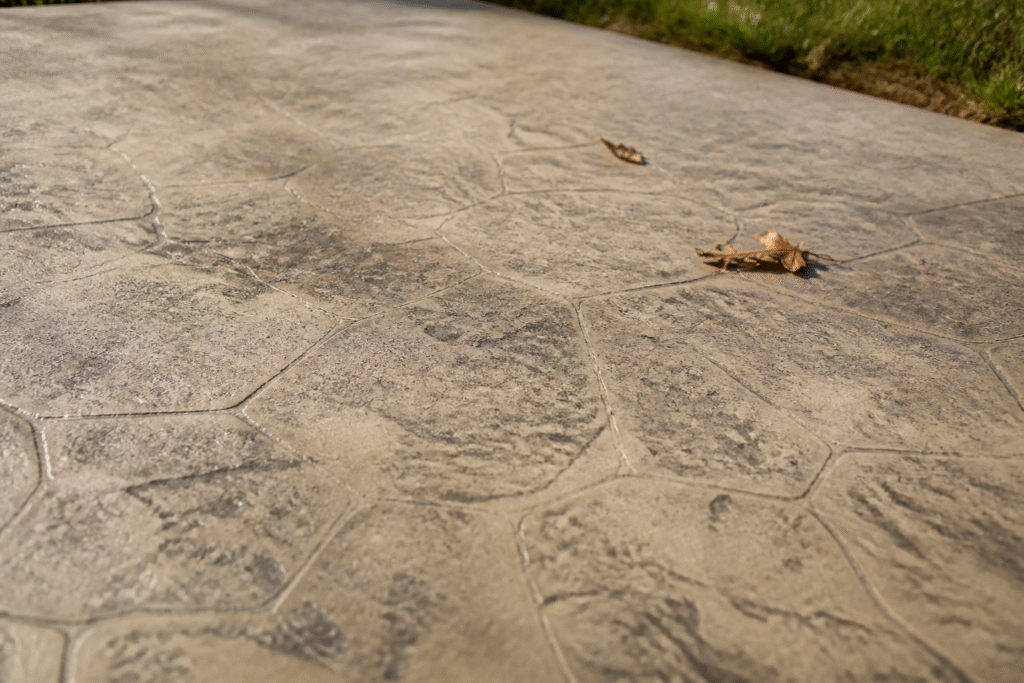
R&J describes concrete overlays as a thin layer of high-strength, polymer-modified concrete over existing concrete, then finished to a chosen texture and color. They list patios, driveways, pool decks, and interior floors as uses. Design options they publish include color, texture, and stencil patterns.
Overlays are the usual answer when the slab is ugly, stained, or lightly damaged, but you do not want to demo it. They can also add texture for wet feet. See also 4 Types of Concrete Overlays and Why Coat Your Concrete Walkway and Porch.
Flake coating — color plus traction
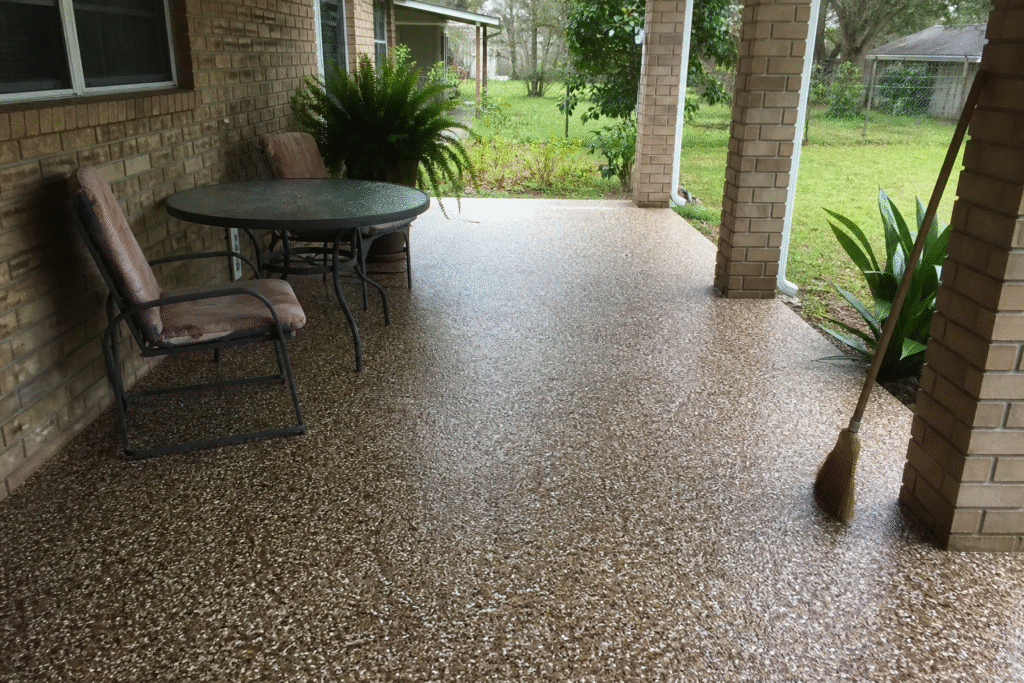
R&J’s epoxy flake system is a multi-layer process: prepare and repair the concrete, apply an epoxy base, broadcast decorative flakes, then a clear topcoat. They also install that system with a polyaspartic topcoat.
For a patio, the topcoat chemistry matters. Common aromatic epoxy resins yellow and degrade in sunlight. That is a materials fact, not a brand claim — aromatic structures in epoxy absorb UV and form yellow chromophores. Aliphatic polyaspartic topcoats are sold specifically for UV resistance. Sika’s Sikafloor-511 is one published example: a polyaspartic finish coat for flake or quartz broadcasts with “excellent UV resistance.” Ask R&J which UV-stable topcoat they will use on your sun exposure. Do not assume a garage flake system is automatically a patio system.
Flakes hide dirt and add grip. That is why they show up on garages and on covered outdoor floors.
Concrete stain — color in the slab, not a thick film
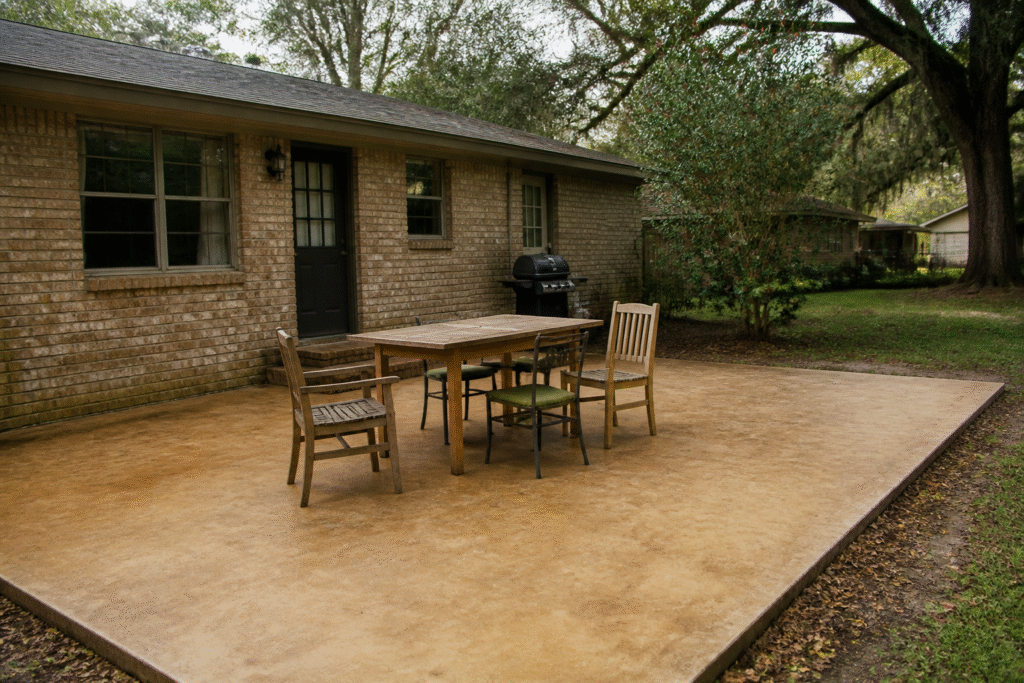
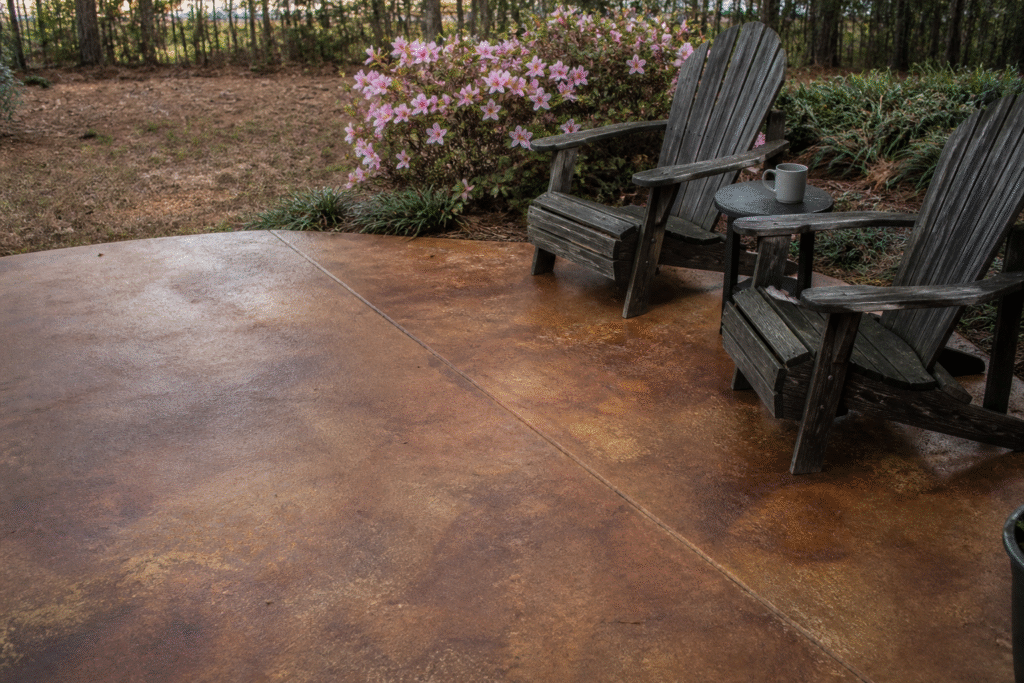
R&J’s concrete staining page says they use stains that penetrate the concrete, in a range of colors, on new or existing slabs including patios, driveways, walkways, and pool decks. They list acid stain, acetone dyes, and water-based stains, plus different sealer types that change the final look.
Stain is the right conversation when you want the concrete to still read as concrete — mottled, not plastic. It still needs a sealer outdoors, and that sealer needs a maintenance plan. It is not a structural fix for a broken slab.
Grind and seal — keep the concrete look, clean it up
Grind and seal is grinding off the weak top layer, then applying a penetrating sealer. R&J describes it as restoring appearance, adding moisture and stain protection, and avoiding full replacement.
This is the quieter patio: less “new floor,” more “this slab was always meant to look like this.” Good when the aggregate is attractive and you want low visual drama.
Solid-color epoxy — mostly indoor or covered
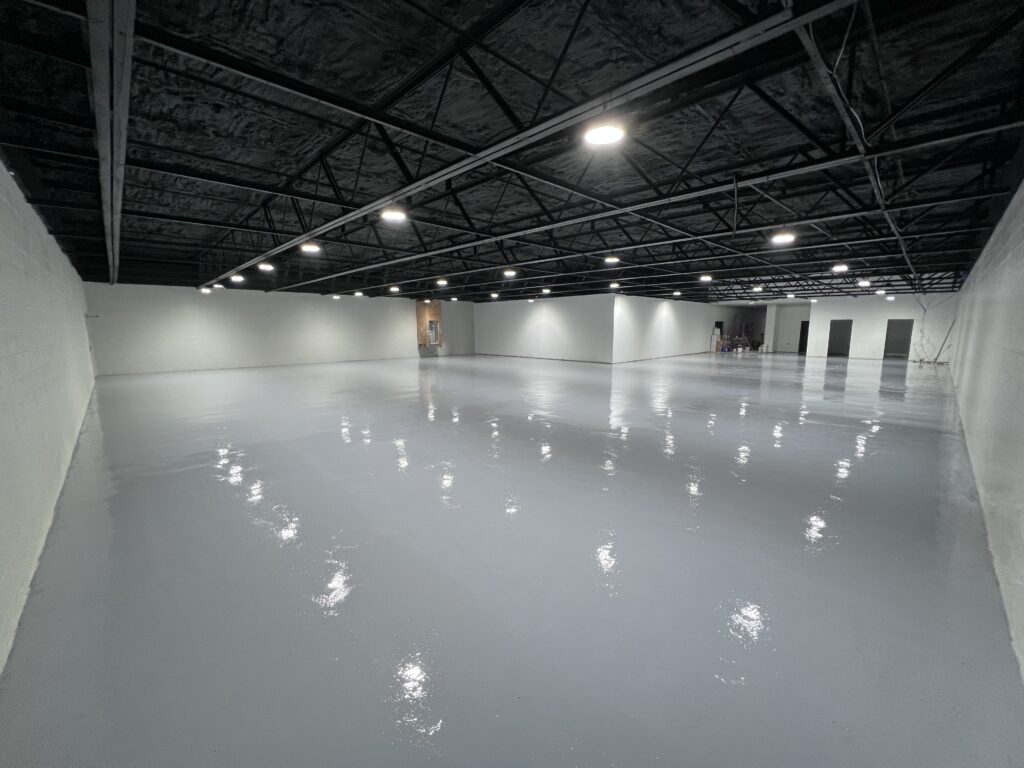
R&J positions solid-color epoxy for commercial spaces where cleanliness matters. They publish a general epoxy cost range of $5 to $12 per square foot, depending on size, product, and existing-floor condition — and say to get a written estimate. Treat that as their published range, not your patio quote.
On a full-sun patio, a smooth solid epoxy is the riskiest of these options: UV ambering if the resin is not UV-stable, and slip when wet if there is no texture. Use it where the slab is covered, or only with a UV-stable, textured finish the installer specifies.
Metallic marble — showpiece, usually covered
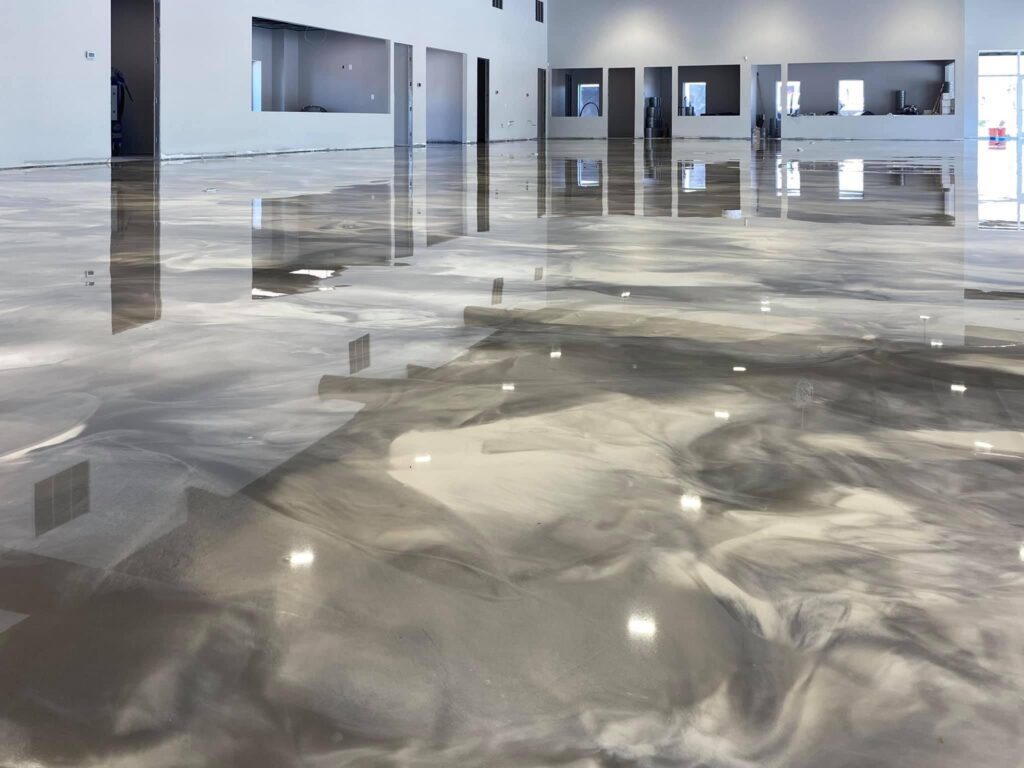
Metallic marble epoxy is a custom, high-gloss marble-look system. It is striking on a covered porch or sunroom. On an open patio it is the wrong default: gloss plus rain is a traction problem, and UV still has to be designed for. If you want that look outside, say so up front and ask for a system built for weather, not a garage showroom transfer.
Pool deck and urethane cement — only if the patio actually needs them
If the patio meets the pool, use the pool deck page: UV, pool chemicals, water, and slip resistance are the design constraints. Urethane cement is the heavy-duty industrial blend (chemicals, impact, wet or oily traction). Most backyard patios do not need it. Kitchens, shops, and wash-down floors do.
Design the layout after the slab logic is set
Once slope and coating family are chosen, draw the furniture at real size.
- Leave walking lanes around tables. A dining table needs pull-out space for chairs.
- Keep the grill downwind of the sitting zone if you can, and off the main door path.
- Align the long edge of the patio with the house opening you use most.
- If you add a pergola later, mark post locations now so you do not drill through a new coating.
R&J’s residential coatings overview sits next to patio, garage, and interior pages if the same visit should cover more than one slab.
Ask for texture on purpose
R&J’s patio and pool-deck pages both list slip-resistant / textured surfaces. Smooth, high-gloss film on an open patio is a wet-weather problem. Flake, quartz, overlay texture, or a grip additive in the topcoat are the usual answers. Decide the feel with a sample board — not from a phone photo.
Some epoxy can be slippery when wet. Anti-slip options exist. Ask for that in the bid.
What to expect on price and time
From R&J’s published site copy:
- Epoxy cost varies; they publish a general $5–$12 per square foot range and tell you to get a detailed estimate.
- Walk-on time for epoxy is often 12–24 hours, with up to about 72 hours before heavy use, depending on product, temperature, and humidity. Follow the system they install.
- They have published 15+ years of coating work in southern Louisiana, based in Hammond (70401), serving Hammond, Baton Rouge, Covington, Mandeville, Ponchatoula, Madisonville, and nearby towns.
Client write-ups live on testimonials.
A simple sequence that does not skip steps
- Decide use, furniture, and whether the patio is covered.
- File 811 if anyone will excavate.
- Confirm slope: 2% away from the house on the slab; site grade away from the foundation.
- Add shade (structure or correctly placed trees).
- Inspect the existing concrete. Repair or replace what a coating cannot save.
- Pick the coating family from the list above.
- Require written prep, product, UV/topcoat, and texture in the estimate.
- Book through appointment request, contact, the quote calculator, or 985-969-1611.
If water already ponds, slope and drainage come first. Then an overlay or coating can finish the surface. Overlay, stain, grind-and-seal, and flake with a UV-stable topcoat are all on the menu — open sun and wet traffic should drive the choice. A new slab is only needed if the concrete is failing.
Sources
- ICC TechNote — Rain & Groundwater Management (IRC R401.3: 2% patio slope; 6 in. / 10 ft grade)
- LSU AgCenter — Best Practices for Paver Installation (811, 2% slope, 1 inch per 4 feet)
- LSU AgCenter — Hardscaping sets the stage for year-round outdoor living
- LSU AgCenter — Reduce utility bills with shade trees (shade; 15 ft setback for large trees)
- Louisiana 811
- Louisiana 811 — homeowner digging rules
- EPA — Soak Up the Rain: Rain Gardens
- Sika — Sikafloor-511 polyaspartic, UV-resistant topcoat
- University of Central Florida — UV degradation of aromatic epoxy